The best relief bills and programs to save small businesses post Covid-19
The Virus and the City: Adjacent Steps
Could assistance be on the mode for Main Street businesses? Here, a rundown of the relief bills and programs that, if Congress acts, might just assistance
Aug. 04, 2020


Five months into the Covid-19 crisis, the outlook for the country's small businesses is as murky equally ever.
 Covid-xix cases continue to rise across the country, slowing and halting many states' reopening plans. Even if we were as far along in combating the virus every bit we had expected to be in mid-July, small businesses' path to recovery would be extraordinarily challenging.
The state'southward minor concern issues existed long before Covid hit. America has not been forming new business or increasing economic dynamism at a sufficient rate since the Nifty Recession.
The almost contempo ready of Small Concern Administration data revealed agonizing trends for Black-owned small business: Their share of all employer firms under-represents the size of the Black population, they are smaller and have lower revenues, and they are highly concentrated in a few sectors. These issues take only become more pronounced due to the coronavirus crunch.
Congress is now up against impossible deadlines, considering the latest round of minor business relief. Mere action is non enough: The right activeness is required.
If the federal government responds inadequately, at that place will probable be devastating ripple effects across Main Streets and the broader economy––suppressing key engines of economic opportunity in distressed communities when they are needed near. If Washington allows entrepreneurship and pocket-size business to languish, the state volition feel the impacts for generations.
Health, Economic Assistance, Liability Protection and Schools Act
The Senate Republicans put frontward the Health, Economic Assistance, Liability Protection and Schools Deed (or "HEALS" Act) earlier this week, which gets office of the way to a responsible solution.
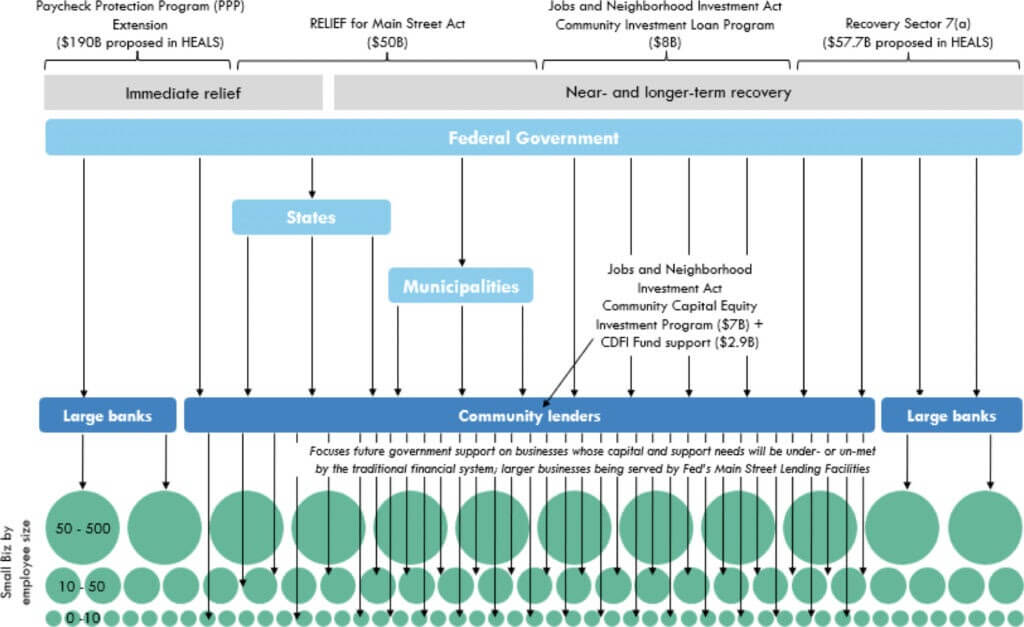
The Act provides a new Paycheck Protection Programme ("PPP") loan product: $190 billion of direct appropriation, partially funded by the remaining unused PPP allocation, focused on modest businesses with 300 or fewer employees and at to the lowest degree fifty-percent reduction in revenue due to Covid-19, and with expanded eligible expenses.
The Act also proposes new Recovery Sector Loans: $57.vii billion of direct appropriation to guarantee long-term SBA 7(a) loans with improved terms for pocket-sized businesses in depression-income census tracts with 500 or fewer employees and at least 50-per centum reduction in acquirement due to Covid.
The terms offered are quite favorable—namely a 1-percent involvement rate over 20 years and a 3-year deferral menstruum before the first payment is due.
Finally, the Human activity recommends $10 billion for registered Small Business concern Investment Companies ("SBICs") that invest in pocket-sized businesses in low-income census tracts, domestic supply chain manufacturers and businesses with significant Covid-19-related revenue losses.
Just the HEALS Act provisions, while an improvement, volition non accost the special challenges faced by very small-scale and minority-endemic businesses. Most importantly, using the SBA's bank distribution network limits the speed and coverage of relief money.
Unbanked and underbanked businesses, which are disproportionately minority-owned, have been less likely to participate in PPP given the program'southward reliance on the mainstream banking system. For minority-endemic businesses that practice take lending relationships and take been able to participate in PPP, discrimination persists.
Based on how the fee construction works, banks likely prefer to originate, say, a $five million loan over a $25,000 loan—a dynamic that disadvantages smaller businesses that are unduly minority-endemic. And, finally, many very small businesses accept short-run not-payroll expenses that exceed the 40-pct threshold permitted under PPP.
RELIEF for Master Street Act
And so, what to practice? We previously advocated for $50 billion in direct funding to state and local governments with the purpose of targeting the nearly vulnerable businesses, and take been working with Senators Cory Booker and Steve Daines as they advance the RELIEF for Main Street Human action, which has connected to gain bipartisan, bicameral, momentum.
The nib builds on local relief efforts that are already actively getting rapid support to businesses. This means that federal resources tin piggyback on top of already established efforts. Across the state, states, cities, counties and towns have established local relief funds to provide emergency support to small-scale businesses impacted by Covid-nineteen.
But local efforts are massively oversubscribed. Many funds received requests for more funding than was available within days or fifty-fifty minutes of the applications opening.
Nosotros go along to believe that allocating $50 billion via state and local funds remains an essential component of whatsoever potential legislative parcel. The strongest proof of concept possible is the huge variety of states and municipalities that take allocated CARES Act Coronavirus Relief Fund (CRF) upper-case letter to respond to their small business concern crises.
The RELIEF for Main Street Act addresses the structural challenges identified above past offer flexible funds through a capital distribution channel outside the banks. This enables broader and more equitable coverage and faster distribution.
- Local relief funds provide more distribution channels, enabling them to reach a broader gear up of businesses more than speedily and with financing that meets the particular needs of very small businesses unexpectedly on the financial brink, or those attempting to optimize during a dull path to stability.
- Unlike PPP and SBA's Economic Injury Disaster Loans, which are one-size-fits-all products, local relief funds are able to tailor financing products—primarily through grants simply too low-interest loans—to the particular needs of small businesses in their communities.
- Local relief funds encourage local partnerships with entities like community foundations, Black chambers of commerce, and others to ensure high-need businesses are able to participate. Banks like Wells Fargo and Depository financial institution of America, or even the SBA, merely aren't able to do outreach and technical help for PPP and EIDL to vulnerable small businesses.
- The RELIEF for Chief Street Human activity too has support across multiple sectors and constituencies. Endorsements include the U.South. Chamber of Commerce, International Franchise Association, Small Business Majority, Small Business Roundtable, Page 30 Coalition, Color of Change, Urban League, African American Mayors Association, Economical Innovation Grouping, the Centre for Community Progress, Community Development Financial Institutions (CDFI) Coalition, Build from Within Alliance, NETWORK Entrance hall for Catholic Social Justice, Associated Builders and Contractors, and over 100 mayors across the country.
Jobs and Neighborhood Reinvestment Act
A 2nd proposed bicameral bill ––the Jobs and Neighborhood Reinvestment Act, proposed past Senators Mark R. Warner, Cory Booker, and Kamala Harris, and in the House past Congressman Gregory Meeks—supplements efforts in the RELIEF for Principal Street Act, by ensuring that if a state does non take capacity to prepare up a local fund by itself, federal capital can fill up in the gaps. Information technology does so by federally investing in CDFIs and Minority Depository Institutions.
 Together, nosotros see the RELIEF for Principal Street Deed and the Jobs and Neighborhood Reinvestment Act, in combination with PPP reform and a new SBA product, as key to a sound recovery.
These bills enable approaches that, as we've stressed before, movement from distinct financial products to a more holistic identify-based approach that focuses on business organization districts and their neighborhoods, rather than businesses equally stand-alone entities.
We have proposed that Principal Street Regenerators serve as an organizing concept to provide the services needed to combat the issues that will exist happening in business organization districts across the land.
As we evidence below, together these funds can provide immediate relief and and then build to a longer-term recovery that is more equitable and spurs a new cooperative federalism.
Bruce Katz is the manager of the Nowak Metro Finance Lab at Drexel University, created to help cities blueprint new institutions and mechanisms that harness public, individual and civic capital for transformative investment. Beth Bafford is Vice President of Syndications and Strategy at Calvert Bear upon Capital, a not-profit investment firm. Jamie Rubin is CEO of Meridiam NA, a leading developer of infrastructure projects in the US and Canada. Michael Saadine is a real manor and social impact investor. Colin Higgins is Plan Director at The Governance Project.
Photo by Tim Mossholder / Unsplash 
Source: https://thephiladelphiacitizen.org/small-business-relief-bills/
0 Response to "The best relief bills and programs to save small businesses post Covid-19"
Publicar un comentario