What Is the Message of the World War 2 Poster to the Right Why Was This Message Important
Getting the Message Out
The Poster Boys of World War II
Summertime 2005, Vol. 37, No. 2
By Robert Ellis
The images and the messages on these government-produced posters, past some of the nation' southward most famous artists, are as powerful today as they were 60 years ago.
There is Norman Rockwell's unequaled 4 Freedoms—a series of paintings depicting the iv freedoms that Franklin D. Roosevelt outlined every bit our reasons for supporting the Allied crusade in World War II: freedom of oral communication, liberty of worship, liberty from want, and liberty from fright.
J. Howard Miller's famous We Can Do It poster, sometimes known as "Rosie the Riveter," provided the bulletin that even with then many men in uniform, America'due south plants and factories would keep on producing state of war materials, with women filling many of those vital jobs.
Thomas Hart Benton's The Sowers depicts grotesque images of German soldiers sowing skulls every bit seeds in a barren field, telling Americans that the High german military was sowing death in every country they conquered. And Ben Shahn created a affiche with the message: We French workers warn you . . . defeat ways slavery, starvation, death.
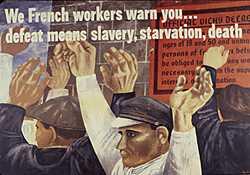
Ben Shahn'south poster of French workers urged Americans to keep up the fight confronting tyranny. (44-PA-246)
These were merely a few of the thousands of posters produced and distributed by the Office of War Information (OWI) during World State of war II to persuade the American people to support the war effort, to conserve the nation's vital resources, to buy saving bonds, and to not reveal possible national secrets.
To go these letters out, however, the federal government turned not to its ain employees or to its military. The government mobilized the Boy Scouts of America.
The massive distribution of posters beyond the U.s.a. during World War II was a challenge. The OWI realized that posters had to be placed in street-level windows of every store, office, restaurant, and "service establishment of every kind" in the United States in order to reach the greatest number of people.
Before President Roosevelt established the Part of State of war Data past executive order on June 12, 1942, four different federal agencies disseminated government information to the public: the Foreign Information Service, the Role of Facts and Figures (OFF), the Part of Regime Reports, and the Partitioning of Information of the Office of Emergency Direction. By combining so many different divisions, branches, and offices into i cardinal organization, Roosevelt sought to avert conflicting and confusing government statements.
The President had crusade for business. When alien reports nigh the loss of naval vessels and the number of lives lost at Pearl Harbor surfaced, the American public began to doubt the official reports from the U.Southward. Government. To reestablish the trust of the people, President Roosevelt created the OWI and directed it to develop information programs to foster an informed and intelligent understanding, at home and abroad, of the status and progress of the war effort and of the government's war policies, activities, and aims.
Because the OWI's mandate covered both foreign and domestic audiences, 2 branches were created: the Overseas Operations Branch and the Domestic Operations Branch. Inside the Domestic Operations Branch, the Bureau of Publications and Graphics was established to coordinate the clearance, coordination, product, press, and distribution of government posters and graphics.
OWI'southward goal was ambitious: to place posters in every city and boondocks across the U.s.. The agency'southward plan called for an ongoing system of distribution; posters would be exchanged for new ones every two weeks. To accomplish its goal, the OWI formed a National Retail Committee, with local capacity in cities and towns across the United States. Each local committee would establish the necessary distribution outlets. For the plan to work, enthusiastic involvement of citizens was crucial. Each committee solicited the help of local shop owners, executives of the Boy Scouts of America, and whenever possible a member of the local Victory Display Committee.
Collectively these local groups had some impact on the subject area matter of the posters they would receive. The National Retail Committee sent local committees and the Boy Scouts sketches for their approval.
The OWI asked various other professional and volunteer organizations to aid distribute its posters. The nigh of import of these organizations were the Outdoor Advertising Association of America (OAAA), Western Marriage, the Association of American Railroads, the National Retail Association, and various women's organizations.
Women were essential to the state of war effort as workers and consumers. When the OWI decided to design a series of posters on how to save the fat in food, information technology targeted its poster entrada to women, peculiarly female manufacturing plant workers, nurses, and homemakers—all of whom were rationing food. OWI found a willing advocate for this poster's distribution at a national publication. Mrs. Louise Sloane, promotion director of Adult female'due south Day mag, coordinated the "Bring together Upwardly" campaign past mailing posters to the YWCA, the New York Federation of Women's Clubs, the American Blood-red Cross, and the American Legion Auxiliary. Owners of beauty parlors were also encouraged to brandish the posters, particularly those relating to rumors, rationing, and the recruitment of nurses.
The OAAA organized an Outdoor Advertising Advising Committee, which encouraged members to be responsible for the distribution of 250,000 1-sail posters a month. The commission gave outdoor advertising businesses verbal directions on how to display the posters. Each outdoor billboard held 24 unlike sheets pasted together to course a single image. The OAAA decided to place the one-sheet OWI poster, which measured 1/24 of the total area of all the combined sheets, in the lower correct-manus corner of each billboard. The larger motion-picture show was therefore unbroken salvage for where the OWI affiche was prominently displayed.
Companies whose businesses spanned a large geographical area also helped distribute the OWI message. These included the outlets of Western Marriage and Postal Telegraph offices, the Association of American Railroads, the Pullman Company, and the Cab Research Bureau. Many small posters were placed in approximately 35,000 coaches past the Association of American Railroads. The Pullman Company also pledged to put national security and anti-rumor posters in every Pullman car. The American Taxicab Association, the National Association of Taxicab Owners, the United Association of Motor Omnibus Operators, the Cab Inquiry Agency, and the American Transit Association pledged to put posters in every cab.
Getting the Message Out, Part 2
Robert Ellis is a reference archivist in the Old Military and Ceremonious Branch at the National Athenaeum in Washington, D.C. Mr. Ellis is responsible for the records of the Us Supreme Court, the United States Court of Claims, and the Commune Court for the District of Columbia.
Articles published in Prologue practice non necessarily correspond the views of NARA or of any other bureau of the United states Authorities.
Purchase This Issue
Source: https://www.archives.gov/publications/prologue/2005/summer/posters-1.html
0 Response to "What Is the Message of the World War 2 Poster to the Right Why Was This Message Important"
Publicar un comentario